
Mare versus highland lunar impact flash light curve dichotomy
D. Athanasopoulos, A. Liakos, A. Z. Bonanos, D. Koschny, O. Sykioti, M. Devogèle, J. L. Cano, R. Moissl
Journal: Astronomy &Astrophysics Letters, 710, 29
Link: https://www.aanda.org/articles/aa/full_html/2026/06/aa60978-26/aa60978-26.html
Abstract
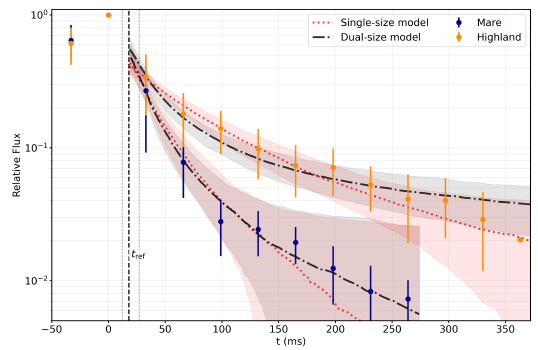
We performed a comprehensive analysis of lunar impact flash (LIF) light curve shapes and their dependence on the lunar terrain, using the large sample of LIFs detected by NELIOTA over the last 9 years. We classified 124 multi-frame light curves into mare, highland, and ‘border’ regions. Subsequently, we derived analytical expressions for single-size and dual-size ejecta cooling models, which we fitted to the observational data to estimate their physical properties. While impacts on the two terrains yield similar peak magnitude distributions, their decay behaviour differs significantly; highland LIFs exhibit a shallower and longer-lasting decay (τ= 0:11+0:08/-0:05 s) compared to mare flashes (τ= 0:038+0:032/-0:018 s). The dual-size model suggests this extended duration is primarily driven by the coarse particles of the ejecta. The profile and duration of the LIF light curves represent the initial stages of the impact cratering process. The observed dichotomy between highland and mare LIFs demonstrates that the initial stages of the impact cratering process are fundamentally dependent on lunar lithology.