
ASASSN-24fw: Candidate Gas-rich Circumsecondary Disk Occultation of a Main-sequence Star
Zakamska, N., Pallathadka, G.A., Bizyaev, D., … Liakos, A., et al., 2026, Astronomical Journal, 171, 95
Link: https://iopscience.iop.org/article/10.3847/1538-3881/ae1fd9
Abstract
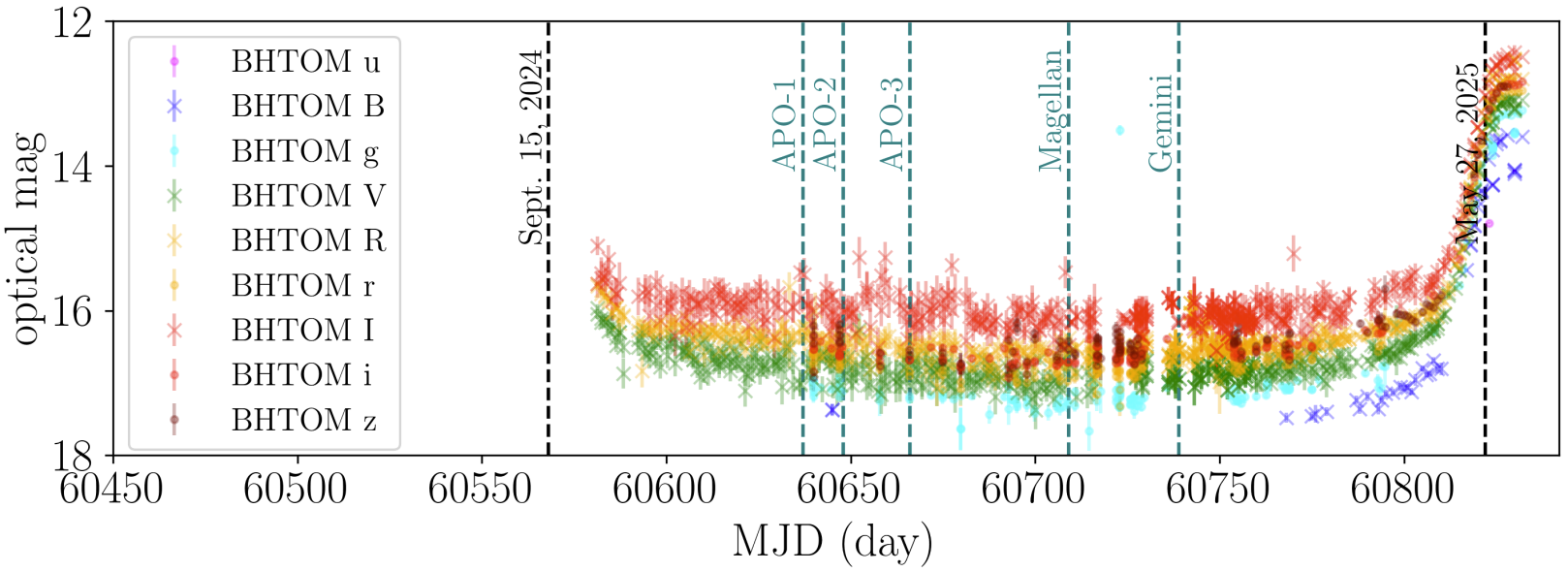
Dusty disks around planetary and substellar companions in outer reaches of exoplanetary systems can be detected as long-lasting occultations, provided the observer is close to the secondary’s orbital plane. Here we report optical spectroscopy with KOSMOS (Apache Point Observatory), MagE (Magellan), and GHOST (Gemini-S) of ASASSN-24fw (Gaia 07:05:18.97+06:12:19.4), a 4 mag dimming event of a main-sequence star which lasted 8.5 months. We discover multiple low-ionization metal emission lines with velocity dispersion ≲ 10 km s−1 blueshifted by 27 km s−1 with respect to the star, as well as kinematically complex Na D absorption. If associated with the occulter, these detections suggest that the occulter is gas rich. Further, we detect a blueshifted and broad (∼200 km s−1) Hα line, which likely originates in the inner circumstellar disk. We confirm the previously reported occultations in 1981 and 1937 seen in historic data, yielding a semimajor axis of the occulter’s orbital motion around the star of 14 au. If the occulter is a circumsecondary disk filling 30%─100% of the Hill radius, we estimate the minimum mass of the secondary to be a few Jupiter masses and a disk mass of 1% of the mass of the Moon. Given the age of the star (>2 Gyr), the disk is unlikely to be a survivor of the planet formation stage and may be the result of a planetary collision. If the Na D absorption and/or metal emission lines originate in the disk, the observations presented here are the first discovery of a circumsecondary disk wind or rotation.